Actions by the Federal Reserve (Fed) In recent months, the US Federal Reserve (Fed) has taken several key actions aimed at stabilising the economy and promoting growth.
– Lowering interest rates: in September 2024, the Fed cut the benchmark interest rate by half a percentage point to a range of 4.75%-5.00%. This is the first rate cut in more than four years. The move is intended to ease funding costs and boost economic activity. Some sources suggest that the next rate cut could come as early as December 2024, with Monetary Committee members anticipating only one quarter percentage point cut this year.
– The Fed is expected to continue cutting interest rates in 2025 if inflation stabilizes at the target level.
The state of the US economy
– Retail Sales: According to the latest data, retail sales rose 0.7% in November 2024, beating analysts’ expectations. This development points to strong consumer demand that continues to drive GDP growth.
– Labor Market: the U.S. labor market continues to trend positively, with the construction sector in particular posting its highest job gains in a decade. This growth confirms the robustness of the US economy.
The evolution of the US dollar
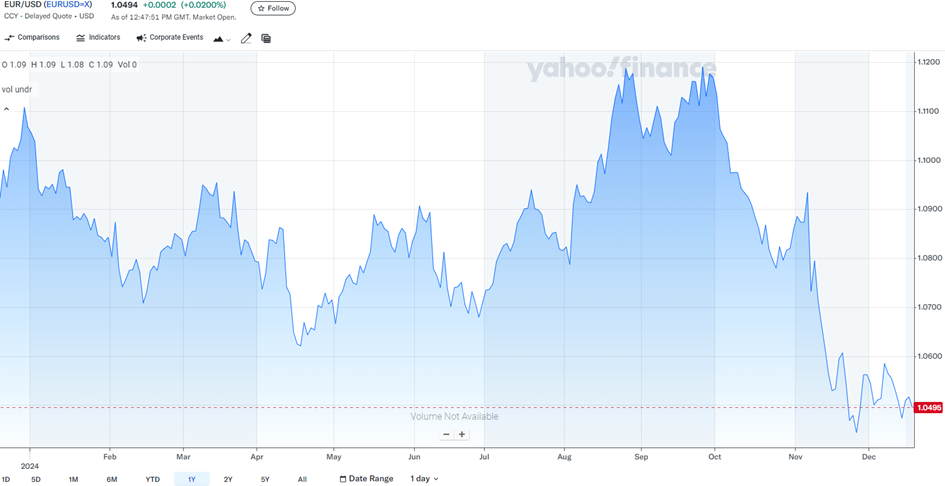
– Short-term outlook: thanks to strong retail sales and continued economic expansion, the dollar has strengthened against most world currencies in recent weeks. This reflects investor confidence in the US economy.
Development of the US dollar
– Short-term outlook: thanks to strong retail sales and continued economic expansion, the dollar has strengthened against most world currencies in recent weeks. This reflects investor confidence in the US economy.
– Long-term forecast: the US dollar is expected to weaken against currencies such as the Czech koruna as a result of the Fed’s loosening monetary policy. Forecasts suggest a decline to levels around CZK 21 per dollar, which could affect the global trade balance.
Conclusion The current economic situation in the US suggests stable growth supported by consumer demand and the labour market. Fed policy is gradually adapting to changing conditions and focusing on the balance between growth support and currency stability. The evolution of the US dollar will depend on the Fed’s next steps and global macroeconomic trends.