American carmaker Tesla Inc. (NASDAQ: TSLA) remains one of the most prominent and talked-about stocks on the global capital market. Although its shares have long been among the most traded and closely watched, current events surrounding the company show that the period of unlimited growth has been replaced by a phase of stabilization and structural changes.
In recent weeks, Tesla announced the signing of a contract with Samsung SDI for the supply of battery systems for energy storage (ESS) worth a total of approximately USD 2.1 billion, with delivery spread over three years. This move confirms Tesla’s growing emphasis on diversifying its activities beyond electric cars, particularly in the energy solutions and autonomous mobility segments.
On the other hand, the automaker is facing declining sales in key regions. According to Bloomberg, Tesla reported one of its largest monthly sales declines in Europe in October. Similarly, Chinese statistics report a year-on-year decline of approximately 9.9% (61,497 vehicles). These figures suggest that the global electric vehicle market is facing strong competition and a gradual cooling of demand.
Financial Performance and Stock Performance
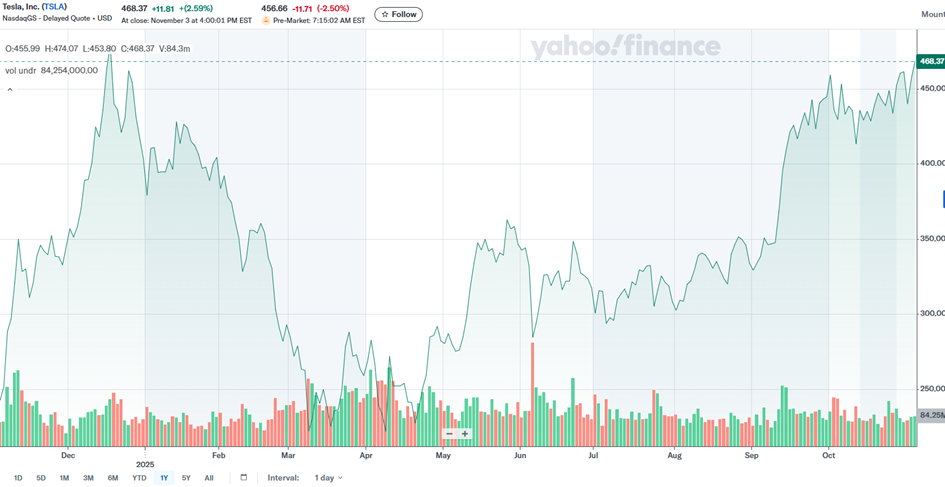
As of November 4, 2025, Tesla Inc. shares are trading at approximately $468.37, representing a slight increase of 0.026% from the previous day. Despite short-term stabilization, however, the stock has experienced increased volatility in recent months. Financial results for the second quarter of 2025 showed a decline in both profits and revenues, despite record deliveries of approximately 497,000 vehicles in the third quarter, partly supported by US tax breaks.
From an investment perspective, Tesla remains a typical growth stock, whose valuation reflects expectations of future earnings rather than current fundamentals. With a market capitalization exceeding USD 1 trillion and a still relatively high P/E ratio, the stock trades at a significant risk premium.
Corporate management and governance issues
The proposed new compensation package for CEO Elon Musk, which could be worth up to USD 1 trillion, is also attracting significant attention. The proposal has sparked controversy among shareholders and institutional investors; for example, the Norwegian sovereign wealth fund has announced that it will vote against it. The debate over compensation highlights the tension between visionary corporate management and the principles of sustainable corporate governance.
Outlook and risk factors
In terms of future development, Tesla continues to invest heavily in autonomous driving technology and plans to commercialize the “robotaxi” concept. This project could fundamentally change the company’s revenue structure, but its success is still more in the realm of expectation than reality.
On the other hand, there are several risks:
a continuing decline in sales in key markets, the loss of some tax incentives for electric vehicles in the US, growing competition in the EV segment (particularly from Chinese manufacturers), and uncertainty about macroeconomic conditions and interest rates.
Conclusion
Tesla Inc. continues to be an iconic but high-risk investment. The company has extraordinary technological potential and a strong brand, but faces pressure to consolidate its position in the global automotive industry. Key factors for further development will be sales results in China and Europe, the ability to maintain operating margins, and the implementation of new technology projects.
For investors, Tesla remains a symbol of dynamism, innovation, and, at the same time, uncertainty, which is an integral part of the technology sector.
Analysts at zacks.com have set an average target price for the short to medium-term investment horizon at a high estimate of USD 600 per share.